The Remembered Islands: The BVI Then and Now
By Claudia Colli
In 1960 a visionary writer wrote: “Sometime soon – tomorrow, next month or a year from now, time is going to catch up with the British Virgin Islands.” From “The Overlooked Islands” by Richard Thruelsen, The Saturday Evening Post.
I looked out of the window on a landscape of empty harbors. The rolling green hillsides were interrupted by a scattering of colorful wooden houses but few roads. This was the BVI I flew into in the mid-1970s, a young city girl who came to work on a charter boat. A friend in New York had suggested I apply for the position of cook on the Tiki, an 80’ Alden Schooner that had once been the boat that Gardner McKay sailed on in the 1959 television series, “Adventures in Paradise”. I had graduated college with a journalism degree and the notion seemed to make sense. Escape a New York winter for a few months while living the dream on a Caribbean sailboat and then fly back to the City to look for a real job!
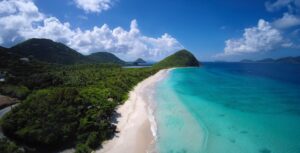
I flew in from San Juan on Prinair, which had a fleet of terrifyingly small prop planes. Along with the flag carrier, Fly BVI, and a few cowboy pilots who flew puddle jumpers, there weren’t many ways to get here by air. I landed on the tarmac at an airport comprised of a few wooden shacks; goats and sheep grazed lazily along the runway’s grassy perimeter. What a fanciful place this is, I thought. I didn’t even need a passport to enter, a drivers license sufficed just fine.
I reached the Tiki after a hair-raising taxi ride along the winding ups and downs of the East End Road The luxury charter boat that I was expecting to work on (did I think I would wear a stewardess’s uniform of crisp white and epaulettes?) was a mess. Its crew was sanding, scraping and hammering to ready it for its first charter in a few week’s time. It was a rocky start to my personal “Adventures in Paradise,” but one that launched me on a decades long journey on these specks of warm tropical islands.
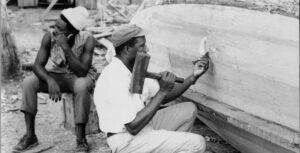
When I arrived, the tourism industry was just getting off the ground. Since the end of slavery in 1834, the British Virgin Islands had been a rural territory of subsistence farmers and fishermen. The roads were more like tracks and to get around, people walked the hills, rode donkeys or horses, or saile island sloops between the various harbors. Some people never left their villages. A prevailing trade at the time was boat building, and craftsmen expertly fashioned both fishing skiffs and the iconic Tortola sloops out of local woods.
One of the earliest guest houses was the charming wooden, Social Inn on Main Street in Road Town. But large hotels were nonexistent. One of the first to dabble in the hotel industry were brothers Charles Roy and Rowan Roy. The Roy family had settled in the BVI at the turn of the 20th century. In 1958, the brothers built Treasure Isle, a charming Road Town hotel embellished with gingerbread, lattice work and open patios. It catered to the islands’ sparse tourists and business visitors and the bar was the place to be on fungi nights when a local scratch band got every one up and dancing. Then in 1964 Charles bought 10 acres of land adjacent to Spring Bay, a pristine white sand beach in Virgin Gorda and built a series of hexagonal wooden cottages he called Guavaberry Spring Bay.
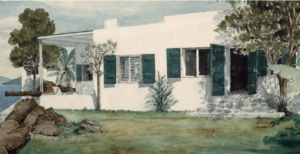
Other early pioneers included Louis and Beth Bigelow, genteel Bostonians, who arrived in the 1930s and ran a private island on Guana Island off Tortola’s eastern end. Invited along to visit one day, I boarded a tender to make the short crossing from Beef Island where I entered a different world. Served by a waiter dressed in a white coat and gloves we drank tea from a porcelain tea pot and cups carried in on a silver tray. I felt like I had been transported to an earlier century.
How did a couple like the Bigelows find Guana Island at a time when few people had even heard of the British Virgin Islands? I know that when I told people back home that I was going to Tortola, they said, where? Did you say Tortuga?
Beth and Louis were a globe trotting couple and according to Beth, finding Guana Island took extensive trial and error research. “After we married,” she wrote, “we decided to find our own utopia, for ourselves and our friends. We travelled the world looking for it – and we found Guana.”
I found one of the most intriguing stories of these early days of BVI tourism in a clipping from the St. Paul Pioneer from November 1958. In it, the author, George E. Sokolsky, recounted his trip to Tortola, which he unkindly described as “one of those down-at-the-heels tropical islands you read about in novels. Only way to get here is by boat through some rough seas, and some would say it isn’t worth the effort.”
He was impressed though by hoteliers Millie and Chris Hammersley who ran Fort Burt Hotel (also known as The Pink House) in Road Town. Millie according to this article, was a character of note. A former fan dancer, she created quite a stir at St. Thomas festival in the neighboring US Virgin Islands when she rode a horse along the parade route dressed – or as it happens, not so dressed – as Lady Godiva. Besides the flamboyant Millie, the hotel bar was noted for its lively atmosphere and 35 cent drinks.
But it was Little Dix Bay, a luxury resort on Virgin Gorda that kick started the tourism industry. It was developed by Laurance Rockefeller, a grandson of the famed John D. Rockefeller, the early 20th century oil and railroad magnate. Laurance took a different turn from his famed robber baron grandfather and became a conservationist and philanthropist with a keen interest in the Virgin Islands, both US and British. He donated land for national parks on St. John in the US Virgin Islands and at Sage Mountain here in the BVI. Then notably, he built the BVI’s first luxury resort on Virgin Gorda, Little Dix Bay, which opened its doors in 1965. Opulent in a refined way, the cottages blended into the property’s lush tropical landscape. The voluminous cedar shingled pavilion covered an open air dining room and became the hotel’s unmistakable emblem.
All that happened before my time, and the day I flew into the BVI, the Territory was experiencing the early stages of development, largely propelled by the development of the charter boat industry. Dozens of small islands, calm and sheltered waters, and a myriad of closely situated anchorages was an irresistible siren call.
In the mid-60s Dr. Robin Tattersall, came to the BVI to fill the post of general surgeon. Tattersall who was as keen on sailing as surgery, boldly launched the BVI’s first bareboat company comprised of several small sail boats. Bareboating (renting a boat without a professional skipper) was a recent innovation. Unfortunately Tattersall’s company turned out to be premature, and soon closed. Others, who weren’t trying to balance operating on the local populace with maintaining a fleet of finicky boats, also saw the BVI’s potential as a sailing center.
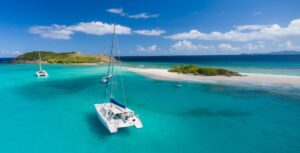
Jack Van Ost, a New Jersey dentist was one of those with just this vision. And in 1967 he launched CSY on a dock at the eastern end of Road Town. Close at his heels was the pioneering couple, Charlie and Ginny Cary, who started the Moorings with just six 35-foot Pearsons in 1969. CSY is no longer in existence, but The Moorings with its sister company Sunsail is today the world’s largest charter boat company.
Cane Garden Bay, now a hub of beach bars, music and water sports had just two beach bars in 1975. The famous Stanley’s Beach Bar sat on a pristine white sand perch and attracted locals and visitors. Stanley Hodge was an amiable host with a wide smile who sold generous lobster dinners with fried plantains and heaps of potato salad and coleslaw. The tire swing hanging from a curving coconut palm out front was its most iconic feature. Everyone wanted a photo of themselves on the tire swing. Just down the beach Jill’s Beach Bar, run by an amiable Canadian sold hamburgers and fries and was a favorite expat hangout.
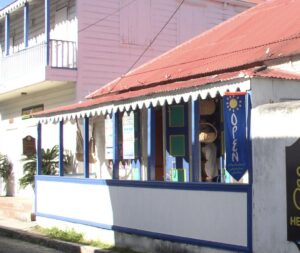
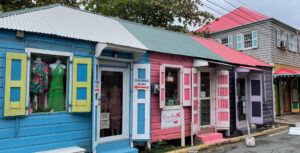
Road Town, once a one street village lined with lovely old wooden homes festooned with hip roofs and graceful verandas, was also undergoing major changes. In the late ‘60s a new waterfront road, built on landfill, cut off the waterfront views of these classic Main Street houses. But on the other hand, it eased traffic through Road Town now that a prospering populace had at least one car in the family.
Developer Ken Bates a blustery British entrepreneur swooped in and seemingly doubled the size of the village overnight. He dredged Road Harbour and filled in the sea surrounding the small islet of Wickhams Cay. This virtual sand desert was punctuated with two banks and not much else. Outraged, the populace protested the usurping of their heritage, and eventually the government bought Bates out. Today what is now known as Wickham’s Cay is a hub of Road Town’s commerce containing 3 banks, a hotel and marina, government offices and dozens of shops. A cruise ship pier has added to the commercial activity and unfortunately the crowding of some of our beaches, but many feel, is a small price to pay if it brings success to local businesses.
I have avidly watched the evolution of the BVI’s tourism industry over the years. It wasn’t rapid, rather a slow and steady evolution. And, although I enjoyed the early years of empty beaches and a slower pace of life, I am also pleased to see the BVI develop a vibrant and successful tourism economy that benefits a swath of the populace.
Being known as “the sailing capital of the world” is certainly a distinction of note. We have some of the Caribbean’s top luxury resorts, and for the past couple of years, direct jet flights to the BVI from Miami. Yet, the BVI remains a bit rough around the edges, maintaining much of its rural charm. There are no franchise restaurants, high rise hotels, or casinos. The cowboy pilots of the air may be long gone, but the BVI has not forgotten its past.
For more information on the BVI go to: https://bvitourism.com
Further information on sailing in the BVI can be found at: https://thebviinsider.com/all-about-sailing-in-the-bvi/