A BVI Rain Garden Raises a Buzz
by Jane Bakewell
Led by Shannon Gore of BVI ARK and a cohort of volunteers, an innovative rain garden is not only pretty, it will control runoff and flooding at the newly built Eslyn Richiez Learning Centre.
There has been a buzz of human activity both inside and outside the newly designed Eslyn Henry Richiez Learning Centre for Differently Abled students. The buzz is the excitement around completion of a striking new one of its kind purpose-built school. Along with this, is a unique landscape design featuring a sensory “Rain Garden,” which will serve as an environmental control for flooding.
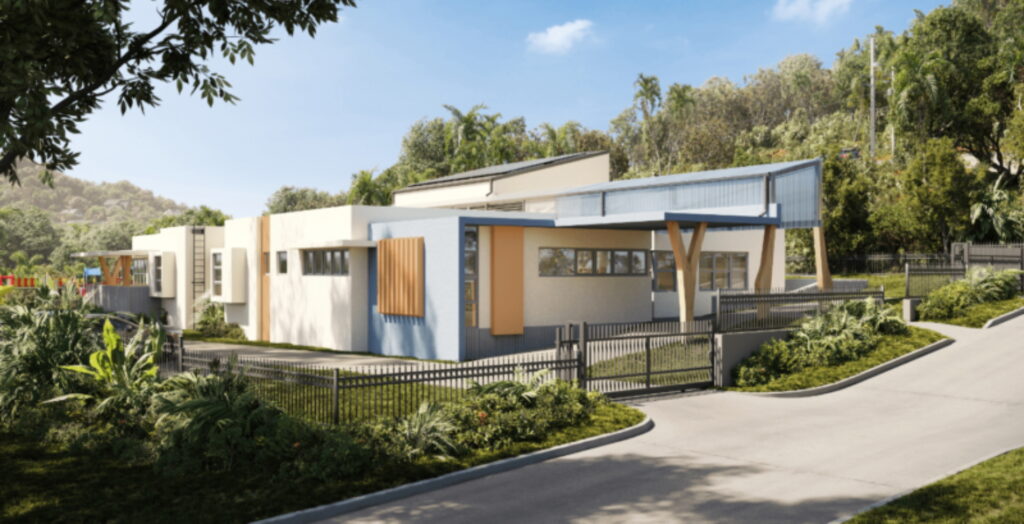
Located in John’s Hole, the school is just down the street from the BVI Red Cross and on the site of the former Magistrates Court building. What “pops” as one drives by is a white contemporary, cubist-design building with tree-shaped wood pillars at the carport entrance and hard-to-miss bright orange vertical slat window coverings. The unique design is the stamp of architect, Lavina Liburd of TigerQi (Qi-pronounced “chi” divine energy) whose studio firm is based both here in the BVI and St. Kitts & Nevis.
Liburd’s work has been described as “tropical modernism” with attention to healthy human living, social integration and environmental sustainability. Thus, her interest goes beyond the building imprint to include the landscape, which must also reflect those concerns.
Enter Shannon Gore of Coastal Management Consulting, who was hired to bring environmental solutions to the property’s natural slope. In the past, excessive rainfall and runoff had damaged the land and buildings below. Dr. Gore, a Marine and Coastal Environment Specialist, saw this as opportunity to demonstrate how a “rain garden” can act to mitigate flooding and sentiment erosion.
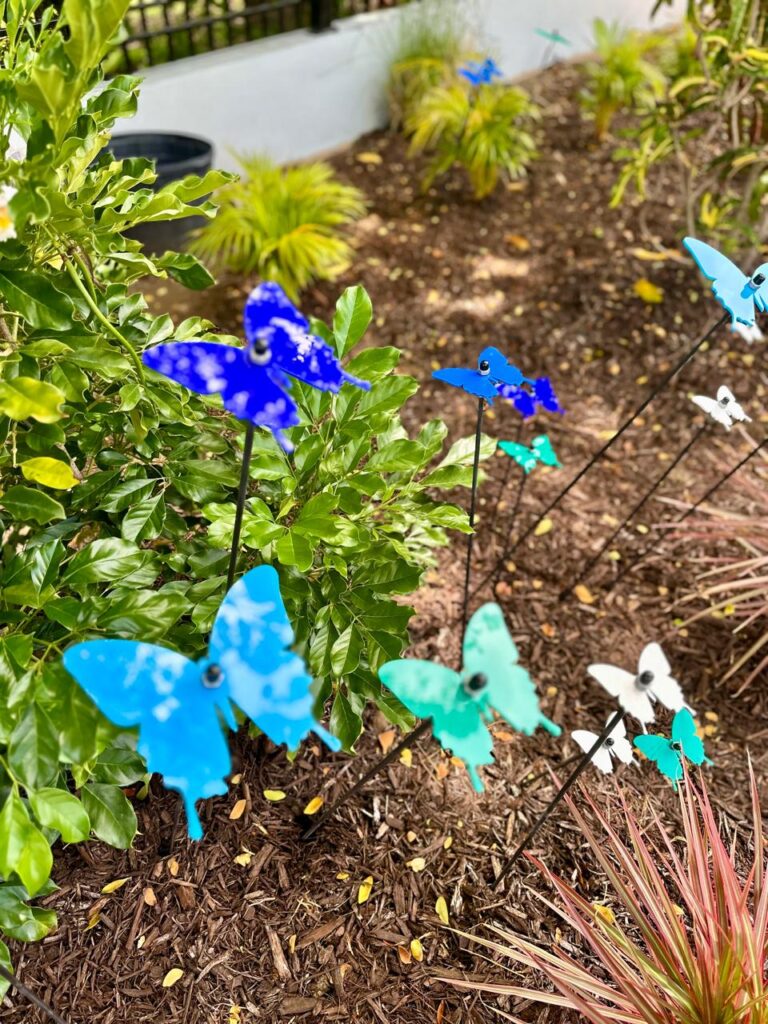
The landscape effort served the overall vision for the property, to be an example of environmental awareness and responsibility. The sloping nature of the hill with development above, including concrete parking areas and open drainage pipes, proved historically to be disastrous in heavy rain conditions. This site had flooded many times with sediment carried down the hill. The rain catchment idea would keep the soil intact, provide for a pool for runoff that would drain easily and provide a natural garden with local plants for visual enhancement
This was not Shannon’s first foray into rain gardens as an environmental solution to flooding and sediment runoff. In 2017, her company designed a Rain Garden for Ivan Dawson School in Cane Garden Bay, which was experiencing continual flooding in their parking area and playground after heavy rains. The principal at that time, who later entered the Ministry of Education, thought the idea was a bit crazy. But after Hurricane Irma, he sang her praises to others in the Ministry of Education.
The challenge for Shannon was how to accomplish this goal within the allocated funds overseen by the Recovery Development Agency (RDA). The Rain Garden was the primary focus, however, the rest of the landscape also needed work and labor costs alone would run over the fixed budget.
“I’m not a landscaper,” Shannon confessed, “and this turned into a much bigger project, so I had to rethink how we could do it within the budget given.”
Shannon’s non-profit organization, Association of Reef keepers (ARK), which concentrates on marine conservation projects and turtle preservation, was where she turned to get community volunteers to assist with the mission.
The BVI Rugby Team stepped up to the plate, as did volunteers from Sail Caribbean Divers. Then came a group of dedicated local hikers from all backgrounds called the “Ghut Junkies,” followed by a handful of art volunteers from Art With Out Limits (AWOL), who assisted with the artful, sensory part of the garden.
Finally, a group of inmates from Her Majesty’s Prison at Balsoms Ghut designed and built a playful, directional standing sign and bench. And a walk-on sensory feature followed in a curving concrete path with 14 individual squares holding large rocks, small white rocks, pebbles, wood chips, and other natural sensory elements. Kick off your shoes and a natural foot massage comes to mind here.
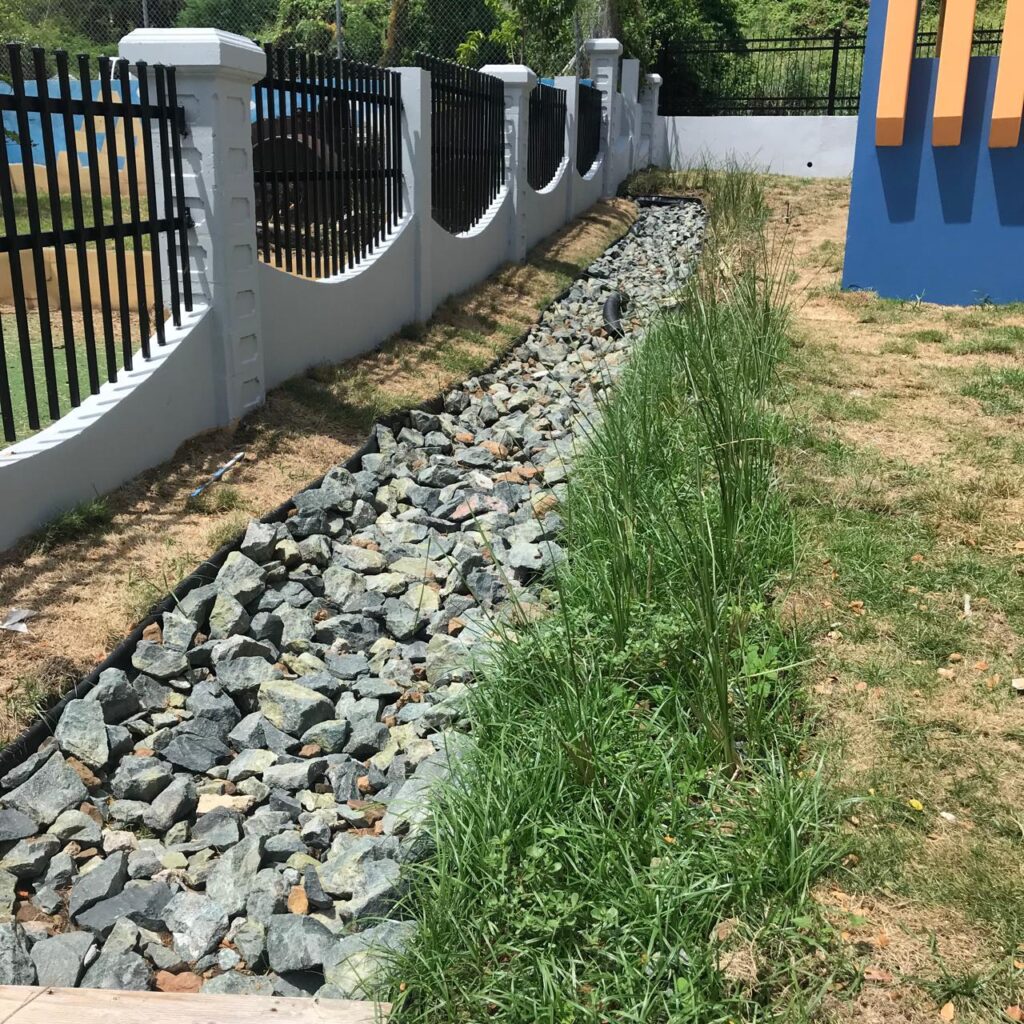
“The work before us was pretty extensive,” Shannon confessed, “we had bare ground with ten and a half pallets of sod squares to lay down, a 1,300 square foot rain garden to dig up and till with topsoil.” The work also included a long water catchment, a shallow, swaled drainage course (bioswale) to dig up, and plant the banks and fill with rocks. However, with the community volunteer effort, they were able to finish in roughly two weeks keeping the costs for the project under budget.
You might ask, what makes a rain garden such a natural solution to prevent flooding? First of all, the long run-off bioswale lined with a porous fabric and stones, slows the water down and allows it to filter. Planted on the banks is a natural grass to the Caribbean, called “vetiver” (Chrysopogon Zizanioides) that has roots that go down six feet and holds sediment providing erosion control. The rain garden at the end then takes the final water and holds it, effectively preventing 90 percent of the nutrients and chemicals from becoming rainwater runoff, polluting other properties or coastal areas. The natural vegetation in this rain garden includes Siver Buttonwood, Golden Beach Creeper, Spider Lily, Frangipani and a young Turpentine Tree.
Most rain gardens hold water runoff for only 24 to 48 hours before it is filtered out or evaporated, so mosquitoes are not attracted. The garden also serves to maintain water quality filtering out pollutants, preserving natural vegetation and attracting birds, butterflies and useful insects. All good reasons to thank nature for having its own environmental control mechanisms.
This project is a model in how to design a school with the special needs of the students in consideration, as well as Caribbean weather and how to create an outdoor environment both visually attractive, interactive and ecologically sound.
For more about the Association of Reef Keepers (ARK) go to:
Read about ARK’s mission to save Noah, a green turtle with a serious disease.