An Iguana in my Garden
By Claudia Colli
The Invasive Green Iguana is a threat to the indigenous Anegada Rock Iguana, a Star of the BVI Natural World
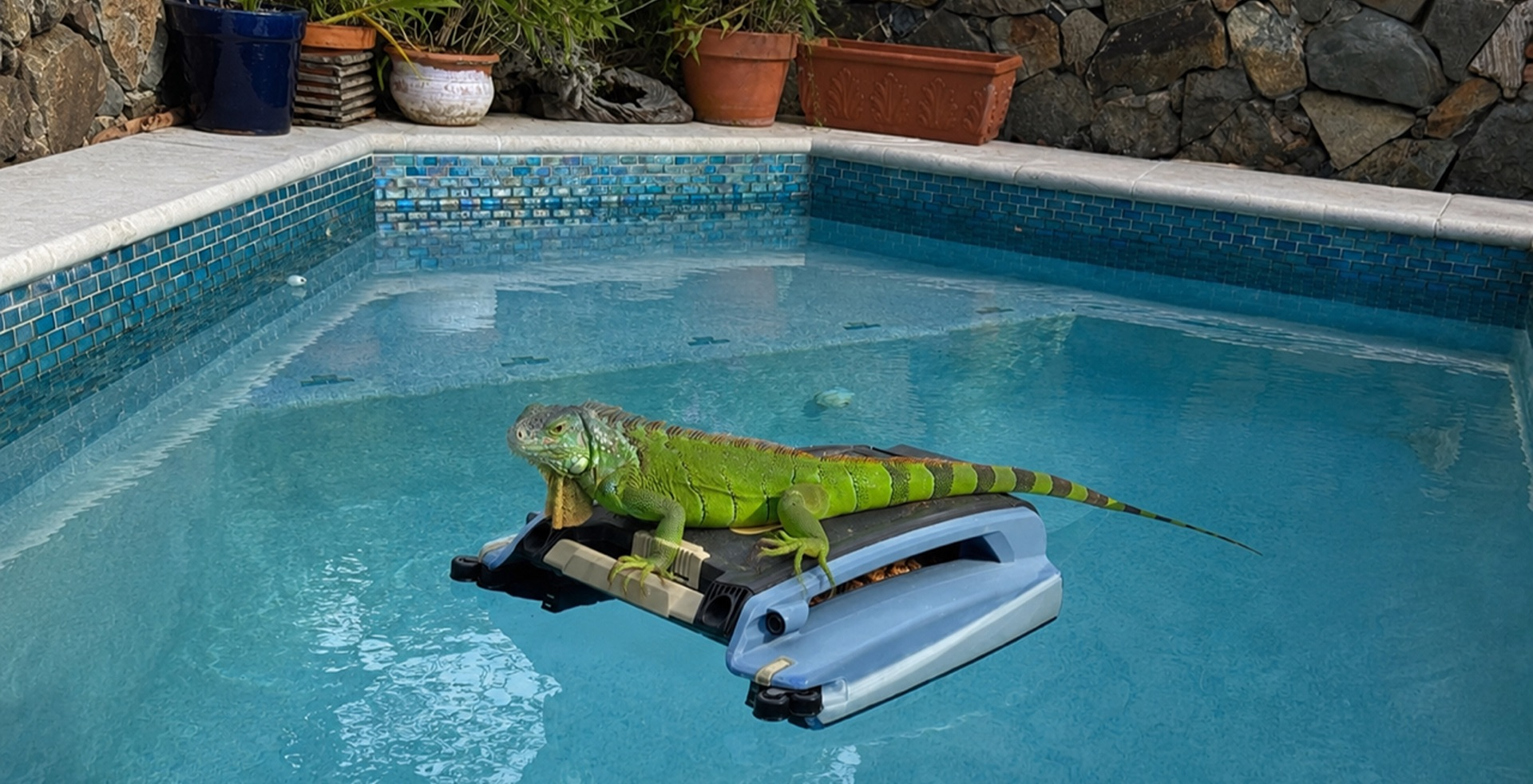
I have an iguana in my garden. One that has taken to riding around on our robotic pool leaf skimmer. I have yet to see it hitching a ride on the skimmer, but I know from its generous droppings that it was there. The image of this bulky green reptile floating around on what amounts to a miniature motor boat is a comical thought. Is it having fun as it twirls around on its tiny raft? Does it get dizzy?
On the other hand, Caribbean conservationists are not amused and are alarmed at the threat that this invasive species poses to the BVI environment.
The iguana, which I have only caught glimpses of as it makes its way across my patio, or sits on the pool edge eying a dip, is a Green Iguana (Iguana iguana). Native to Central America, it may originally have been brought to the island as a pet. Eventually escaping captivity, and in pursuit of love perhaps, this prolific reproducer must have found a fellow escapee, launching a small but persistent population around the islands. Beyond my garden I have seen them darting across the West End road, and on Virgin Gorda and Peter Island, among other places.
The West End of Tortola, has dense foliage and is a perfect place for these reptiles to hang out. They have a taste for flowers and other garden delicacies (at one time, I watched staff at Biras Creek feed a particularly robust fellow hibiscus blossoms as a treat). But on the other hand it is less amusing when they munch on your own hibiscus bush.
They can also can play havoc with native species.
A workshop hosted by the Virgin Islands government in March 2026 aimed to address the danger they could pose to native species including the endangered native species, the Anegada Rock Iguana (Cyclura pinguis).
The training program brought together a variety of government agencies and institutions representing such disparate locales as the UK, Sweden, Puerto Rico, Florida, Dominica, and of course, the British Virgin Islands.
The workshop, was organized by the Ministry of Environment, Natural Resources and Climate Change, in collaboration with the Centre for Applied Marine Studies at the H. Lavity Stoutt Community College. The meeting aimed to build “local capacity across key management areas for the invasive Green Iguana.” A targeted action plan to address the species’ ongoing and increasing impact on the Territory’s biodiversity, agriculture and environment were on the agenda.
Angela Burnett Penn the British Virgin Islands Director of Environment, in the Ministry of Environment, Natural Resources and Climate Change, explained the danger presented by the green iguana this way: “The invasive Green Iguana poses a growing challenge to our native ecosystems and species, the agricultural sector, and infrastructure.”
The Anegada Rock Iguana, A Star of the BVI’s Natural World
The invasive Green iguana population poses a particular risk to the endemic and critically endangered Anegada Rock Iguana through competition and hybridization.
The Rock Iguana is one of the BVI’s most well-known creatures – and its endangered status makes its protection a priority. Native to these islands, the Anegada Rock Iguana is enigmatic and elusive. The reptile’s natural bastion is Anegada, but it can also be found on protected habitats on Guana Island and Necker Island where they were transported in a conservation effort.
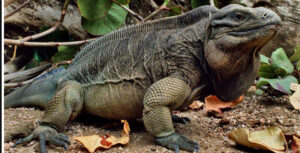
The Anegada Rock Iguana looks like a relic from the prehistoric past. Close to two-feet long with a chunky body, bowed legs, and a spiky dorsal crest which fans from the top of the male’s head like an elaborate headdress, the Anegada Rock Iguana may not win a beauty contest, but its charms are many.
Vulnerable to habitat loss, and predation by cats and other animals, the Rock Iguana has been on the decline for decades. with perhaps 90% of iguanas victims of feline predation. Hence the importance of making sure the Green Iguana does not get a foothold in the Rock Iguana’s habitat.
The trend though is being reversed through active conservation methods, which includes the protection and nurturing of young Rock Iguanas. Each year volunteers scour the iguana’s habitat to find hatchlings. They are not easy to find. The nests laid in the ground can be camouflaged by the island’s dry scrub. National Parks staff are adept at finding them though, and when they spot hatchlings, they transport them to the Head Start facility located in the Settlement, as the area is called.
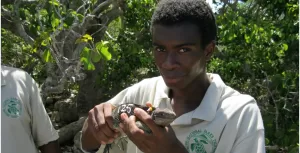
The facility’s enclosures are strong and durable withstanding even Hurricane Irma in 2017. The zoo also supplies much needed equipment like food processors for chopping food; lettuce being an iguana favorite. A visitor center at the Head Start facility was funded by a grant from the European Union.
“The Cyclura pinguis is one of the oldest of the rock iguanas of the Caribbean,” explained Nancy Woodfield Pascoe, the Virgin Islands National Parks Trust Deputy Director. “It is the one on the top, so all the others are descendants of it.” There are 50 species of iguanas in the world and 16 are found in the Caribbean; the Anegada Rock Iguana is one of the most fascinating.
Next time when you are an Anegada, put the Head Start facility on your itinerary. You will meet a variety of baby and adolescent Rock Iguanas and learn more about these remarkable creatures.
For more about the work of the National Parks Trust go to: bvinpt.org
Or learn more about the founding of the VI National Parks Trust here: